Alberta vs. Ontario

I was able to come across several policy related documents for the province of Alberta, but the documents seem to be outdated with one being more than 15 years old. The only document below to make explicit reference to geriatric mental health was “Aging Population Policy Framework.” There were no benchmarks listed in this document, which makes it challenging for accountability to be had.

  • Aging Population Policy Framework (2010)
    • “provide leadership and support for initiatives which enhance knowledge about the mental health needs of seniors, and partner with key stakeholders and service providers to develop innovate responses to these needs.” (p. 28)
    • “support rural Albertans in accessing health services, including those related to mental health, and facilities that support complex care.” (p.29)

The government of Ontario appears to have the following geriatric policy related documents:

My critique of this Ontario document again is that it lacks benchmarks – how do we know what measures success? The action plan indicates three areas of focus (1) support seniors at all stages, (2) supporting seniors living independently in the community and (3) seniors requiring enhanced supports at home and in their communities and (4) seniors requiring intensive supports.

Undergoing this preliminary search lead me to reflect more on who’s responsibility is it to create mental health policy for seniors? Our provincial government can have a new party in power every 4 months, it seems both necessary yet unsustainable for these policy action plans to be recreated every few years. Additionally, another observation I made was that there is no standardization as to what types of documents are being produced from the province. Ontario makes an “Action Plan” and Alberta creates a “Policy Framework” and “Strategic Framework.” This, adding to the challenge of comparing the two provinces objectively.

While undergoing my search for related policy documents coming from the provincial level, I stumbled across other jurisdictions. This included the Canadian Medical Association, Association of Municipalities Ontario, Regional Geriatric Program of Toronto. Can these third party agencies take responsability in shaping mental health policy for seniors? This would support Horgan’s point that “policies be informed by older adults who experience mental health issues to ensure that they adequately meet their needs and are in-line with their values (2019)”

References:

Horgan, S. (2019) Mental health policy for older adults. [Online]. Retrieved from https://onq.queensu.ca/d2l/le/content/321165/viewContent/1868392/View


Nursing Anecdotes

As the same for Module 3, these interviews are intended for peer learning and are not to be shared with a broader audience. This interview was inspired by the Robinson article, which speaks to the anomaly of male psychiatric nurses. For context, George began his career (more than 30 years ago) in geriatric psychiatry and later transitioned into adult psychiatry at Alberta Hospital. This brief interview provides more information on the working responsibilities of psychiatric nurses, inservice training, unique tasks as a male nurse, and he shares two stories with patients.

I deeply respect and appreciate the work my parents have done in psychiatry. I think it requires a lot of patience and perspective. George finishes the interview by emphasizing how important it is to take things lightly. He also incorporates a bit of humour into his response, which I think is needed in this line of work. As Robinson disclosed, we will need to ensure that we are attracting new, younger nurses into geriatric psychiatry as there appears to be an aging out of the work force (2010). Alas, my parents have both retired in the last 5 years.

References:
Robinson, K. M. (2010). Policy issues in mental health among the elderly. Nursing Clinics of North America. 45 (4) 627-624. https://doi.org/10.1016/j.cnur.2010.06.005

About Me

Hello! My name is Lauren, and I am the author of these blog posts. I was born and raised in Edmonton, Alberta – where I continue to live as I complete my online Master of Science in Aging and Health from Queen’s University, Kingston, Ontario.

I completed my Bachelor of Science in Human Ecology from the University of Alberta. I also have two certificates from the University of Alberta in Sustainability and Community Engagement.

I balance my current full-time job as a Student Advisor, with my work in my community – both as a Board Member of a local non-profit agency, and as a volunteer driver for seniors. I am passionate about helping people and making a positive impact on the world! I have keen interest in gerontology with issues relating to retirement, intergenerational relationships, housing, and age-friendly communities.

Integrated Care Example

Sage, is a non-profit organization in Edmonton which has been supporting the older adult population since the seventies. Over the decades, this organization has been a champion in senior services. Sage has housing, social engagement, food services, fitness, and education programs.

I had the privilege to intern on the board of directors for this non-profit organization. It was an integral time in the organization, as it was leading up to the approval of their major integrated health services project. The goal was to have an integrated health services clinic, within their service facility. It would be primarily run by nurse practitioners to assist with annual checkups, health assessments, treatment for chronic and acute illness, prescription and refills, health information and education, diabetes and respiratory health programs, and urgent care. Sage also has the capacity to support community dwelling seniors’ mental health as they have a team of social workers that take on case loads. This project was 8 years in the making and had to overcome many permit and funding barriers.

The vision for this integrated care model was for the senior to have a one-stop shop for all of their holistic needs, including mental health.

Sedation & Restraints

People with schizophrenia can experience some unique symptoms including paranoid through process, delusions, hallucinations, disorganized speech, and flat affect (Horgan, 2019).

Lauren from Living with Schizophrenia

Although this person is not an older adult, she does provide an interesting narrative for what being in a mental illness institution looks like. Lauren acknowledges that this was her own personal experience, and the experience of others in an institutional setting may vary. Lauren describes her experience of being held back with restraints and administered medication against her will at minute 2:25. This of course in context, was to prevent her from self-harming which she describes trying to strangle herself with her hospital gown. Lauren then goes on to describe how this experience was traumatic and presumably worsened her overall mental health to be confined in a “prison-like” institution.

Elyn Saks, who delivers her own TEDTalk on living with Schizophrenia, describes the restraints on her body as unnecessary as she did not harm any one nor make any direct threats. Rather, she notes that these restraints are actually harmful to the patient – “every week in the United States, it’s been estimated that one to three people die in restraints each week. They are strangled, they aspirate their vomit, they suffocate [or] they have a heart attack (2012).”

Elyn Saks from A Tale of Mental Illness

What surprised me about Lauren’s and Elyn’s videos are their vivid recollections of their experiences, despite being in psychosis. I had made an assumption that this wouldn’t be the case. Surely there must be a more dignified way to support patients in hospitals. This video raises an interesting policy and ethical debate regarding non-maleficence and autonomy. Based on current policy, it sounds that non-maleficence is more binding than autonomy. How could the Mental Health Act (as per the Main Post of Module 5) be amended to support a more humanizing and supportive environmental for patients who are admitted into an institution for their mental illness?

References:

Policy on Prevention and Intervention

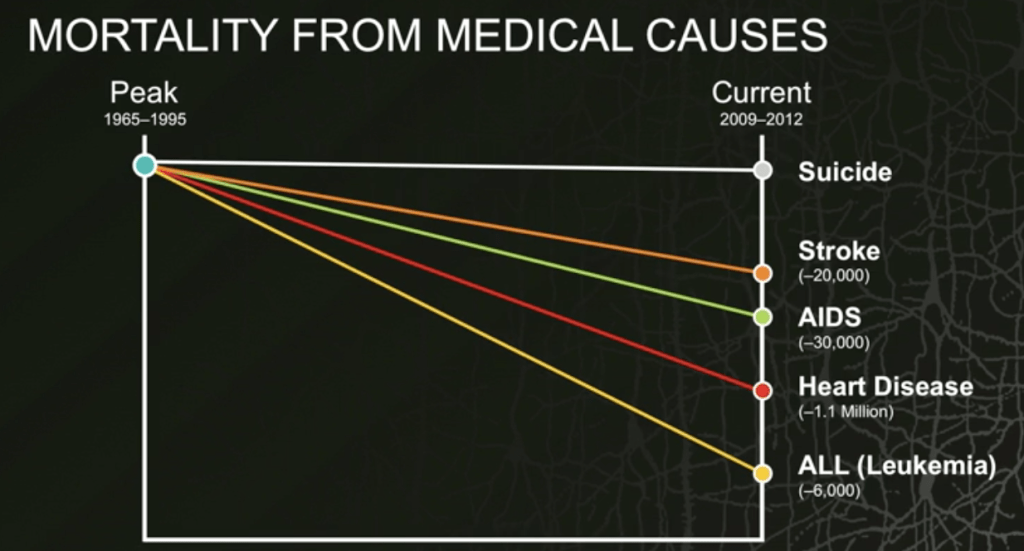
Mortality from medical causes has greatly improved over the last 50 years thanks to biomedical research (Insel, 2013). However, suicide, one of the leading events of mortality, has not improved (Insel, 2013). Thomas Insel indicates that 90% of suicides are related to a mental illness (2013). Insel mentions that early detection and early intervention is what has contributed to curbing mortality rates in leukaemia, heart disease, AIDs. and stroke (2013). Yet suicide and consequently mental illness has yet to decrease their mortality rates.

Screenshot from Insel’s Ted Talk “Toward a new understanding of mental illness”

Insel discloses that mental disorders are very common, can be disabling, and that the majority of cases are early onset before the age of 24 (2013). There has been recent emphasis on mental health research from the federal and provincial levels. Large government-driven initiatives such as ACCESS Open Minds, are funding the early detection and prevention for mental health concerns in peoples under the age of 25. I am hopeful that this type of investment will help our younger generations access the mental health services they need and to be able to manage and a holistically healthy life. As Horgan indicates mental illness is easier to detect in younger generations, “because symptoms associated with mental illness do not always have the same underlying cause in older people as in younger people” (Module 4 Slide deck, 2019). 

With this focus on early prevention for Gen Z and Millenials, I am left to wonder what is now left for the Baby Boomers, and those who are in their older years. Older adults face a double edge sword in this circumstance, as it is more challenging to detect mental illness and they have grown over the generations with so much stigma around mental health that it may be challenging to identify within themselves, or come to terms with such a diagnosis. Additionally, Segal, Quallls and Smyer reference that older men, generally 80 years of age or older, do not identify themselves as having depression – rather they call themselves crabby, grouchy, irritable or simply apathetic (2018, p.210). It sounds like to me that these particular research participants appear to be victims of an ageist world. 

Policy is needed to help guide mental health support and services for our older adult population. Our approach to an effective model of care for mental health needs to be two pronged. One, focusing on the prevention at an earlier age, but secondly an intervention mechanism which could capture those older adults who were not apart of the prevention cohorts. Federal of provincial emphasis on health policy would ensure the holistic needs (which includes psychological, meaning mental health) of our population are being met.

References:

Alberta Hospital

My parents spent the majority of their careers at what they refer to as “Alberta Hospital.”  This facility is located in the rural outskirts of Edmonton, Alberta and has experienced the wrath of deinstitutionalization. The facility was originally founded in 1911 and experienced many name changes such as Alberta Mental Hospital, Alberta Hospital for the Insane, Provincial Mental Health Hospital, Ponoka Mental Hospital, and Ponoka Insane Asylum. The wording choice in the facility name alone implies how mental health, illness, and treatment has been stigmatized over the decades. Robinson posits that “society needed protection from people with mental illness by providing care in isolated institutions on the outskirts of town (2010, p. 628). A CBC article references that 246 Alberta Hospital beds were closed and redistributed throughout the Edmonton area in either general hospitals or community services (2009). My dad’s unit remained functional, as he worked on a different, non-geriatric unit, but my mom’s unit was one to experience the closures. She was then relocated to a geriatric psychiatric unit in a different hospital. My parents recall the petitioning, and many clinicians voicing their concerns with cutting beds.

My parents were dedicated registered nurses, both working in geriatric psychiatry (which is where they met in 1983). Collectively, they have spent nearly 50 years dedicated to their careers in this field. Irene spent her career in geriatric psychiatry, and George started in geriatric psychiatry and later went on to adult psychiatry. They are now retired. Throughout this blog, I will make reference to their stories regarding the subject matter – which can be found in Module 3 and Module 5.

References:

The 1970’s Public Policy of Deinstitutionalization

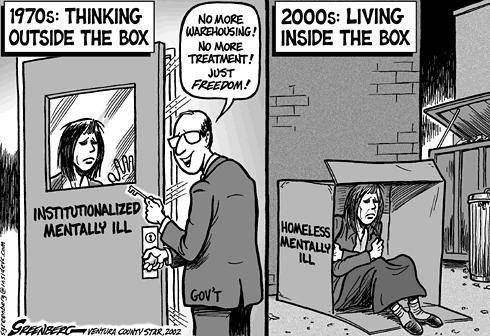
In Chapter 1, of Aging and Mental Health, Segal, Qualls, and Smyer reference a paradigm shift in the way mental health services were delivered (2018). The authors note that, “inpatient services were shifted from state mental hospitals to private psychiatric hospitals, psychiatric units in general hospitals, and “swing beds” in general hospitals (Segal et al., 2018). Deinstitutionalization was a nationwide policy to encourage more emphasis on community based psychiatric services (Sealy & Whitehead, 2004). Beginning as early as the 1960’s to 1970’s, provinces have slowly begun to take action on cutting down psychiatric hospital beds. Sealy and Whitehead, provide a 40 year empirical assessment of deinstitutionalization across Canada, and note that there has been wide variety between the timing and intensity of cutting beds (2004).  Authors Sealy and Whitehead elaborate more on the three components required for deinstitutionalization of psychiatric hospitals (2004): 

  • 1) the shift away from dependence on mental hospitals
  • 2) “transinstitutionalization,” or an increase in the number of mental health beds in general hospitals
  • 3) the growth of community-based outpatient services for people with mental illness.” 

At first glance, I can infer a few values from this public policy. Reducing psychiatric hospitals beds and facilities can redistributes the negative stigma that is associated with “insane asylums.” Additionally, per capita costs for community based services are now more evident, which alleviates pressure on the health care system (Sealy & Whitehead, 2004). However, cutting public funds for particular initiatives tends to imply where priorities and values lie. Do these cuts to psychiatric hospitals imply is that mental illness support is not as highly valued by the government? I continue to contemplate whether this decision was morally “good” or “bad.”

References:

  • Sealy, P. & Whitehead, P. (2004). Fourty years of deinstitutionalization of psychiatric services in canada: An empirical assessment. Canadian Journal of Psychiatry 49(4). Retrieved from https://ww1.cpa-apc.org/Publications/Archives/CJP/2004/april/sealy.pdf
  • Segal, D. L., Qualls, S. H, & Smyer, M.A. (2018) Aging and mental health. (3rd ed.). UK: Wiley Blackwell

Design a site like this with WordPress.com
Get started